Africa Faces Growth Slowdown as Middle East Conflict Pushes Millions Toward Cost-of-Living Crisis
BaseLine Team
05 Apr, 2026
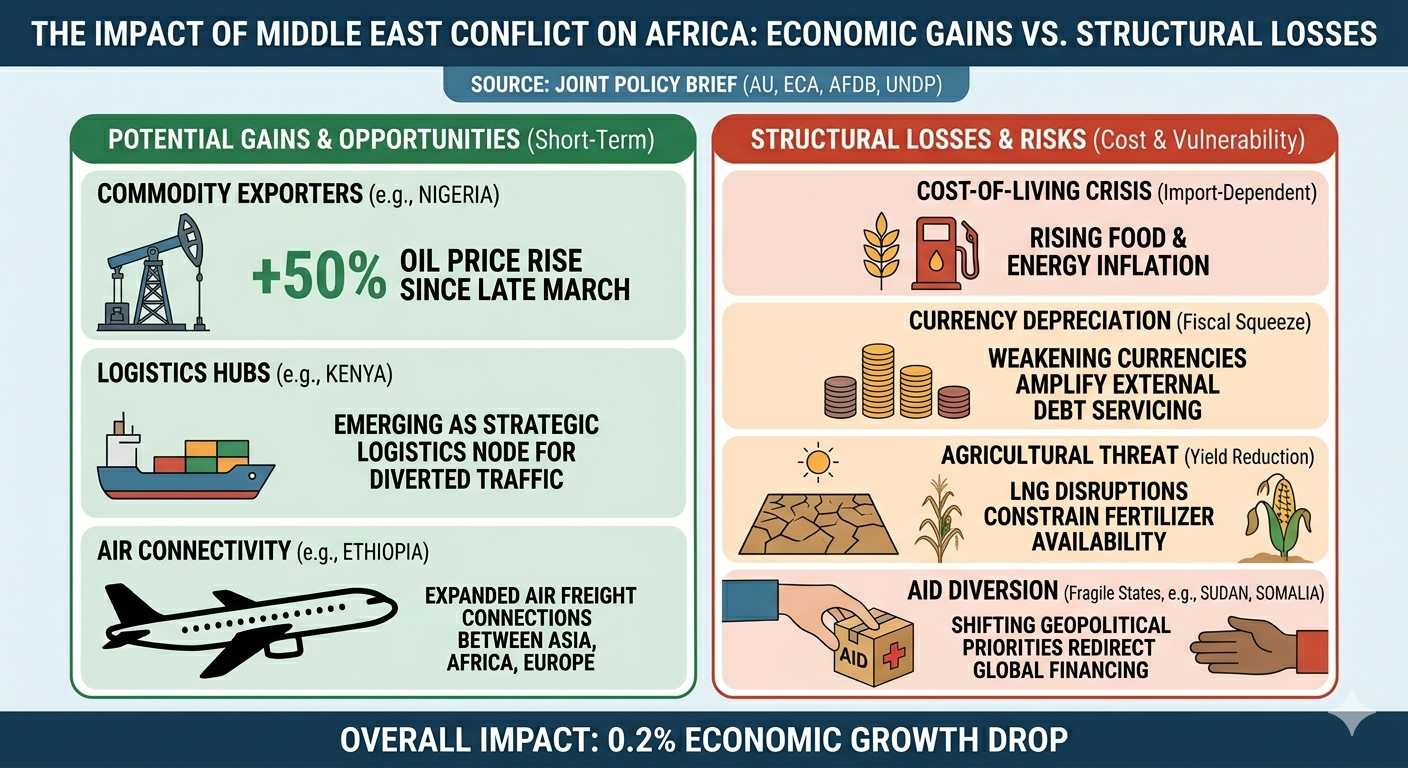
Africa could lose at least 0.2 percentage points in economic growth this year if the Middle East conflict persists, as rising fuel and fertilizer costs begin filtering into local economies, pushing millions of households closer to a cost-of-living crisis.
That warning comes from a joint policy brief by the African Development Bank Group (AfDB), African Union (AU), United Nations Development Programme (UNDP), and United Nations Economic Commission for Africa (UNECA), which frames the conflict as an external shock with disproportionately domestic consequences for African economies still recovering from the pandemic.
ENERGY
Oil prices have surged by as much as 50pc since late March, transmitting inflationary pressures across import-dependent economies. For governments already grappling with tight fiscal space, the result is a familiar squeeze such as higher subsidy burdens, rising import bills, and weakening currencies. The brief notes that nearly 30 African currencies have depreciated in recent months, amplifying the cost of servicing external debt while eroding purchasing power at home.
AGRICULTURE
Disruptions to Gulf-based liquefied natural gas supply that is critical for producing ammonia and urea are constraining fertilizer availability just as much of Africa enters its main planting season. The timing could prove costly. Reduced fertilizer access is likely to depress yields, pushing food prices higher and intensifying food insecurity, particularly among low-income households.
Why Africa Is So Affected
The Middle East accounts for roughly 16pc of Africa’s imports and over 10pc of its exports, making the region a critical trade corridor. Any prolonged disruption, especially along strategic routes such as the Strait of Hormuz, feeds directly into shipping costs, insurance premiums, and supply chain delays.
Still, some economies are positioned to benefit in the short term. Oil exporters such as Nigeria stand to gain from elevated prices, while countries along alternative shipping routes are seeing increased maritime traffic as vessels reroute around the Cape of Good Hope. In East Africa, Kenya is emerging as a logistics node, while Ethiopia’s national carrier is playing an expanded role in maintaining air connectivity between Asia, Africa, and Europe.
These gains, however, are unlikely to offset broader pressures. Inflation risks remain elevated, fiscal buffers thin, and external vulnerabilities exposed. For fragile and conflict-affected states, the stakes are higher still. The brief warns that shifting geopolitical priorities could redirect global financing toward security spending closer to the conflict zone, leaving less room for humanitarian and development support in places like Sudan and Somalia.
The geopolitical dimension is also hardening. The crisis is intensifying competition among global powers like the United States, China, and Gulf states for strategic influence across Africa’s ports, minerals, and trade routes. For policymakers, this adds a layer of complexity to an already difficult economic space.
In response, the report calls for a sequenced policy approach.
IMMEDIATE TERM
Governments are urged to secure fuel and food supply through coordinated procurement, emergency financing, and targeted social protection. Central banks, meanwhile, face the delicate task of containing inflation without choking off growth.
MEDIUM TERM
The focus shifts to expanding domestic refining capacity, strengthening regional trade under the African Continental Free Trade Area (AfCFTA), and rebuilding fiscal buffers.
LONG TERM
The institutions advocate for a more structural shift, reducing reliance on external supply chains and building continental systems for energy, food, and financial security.